


4
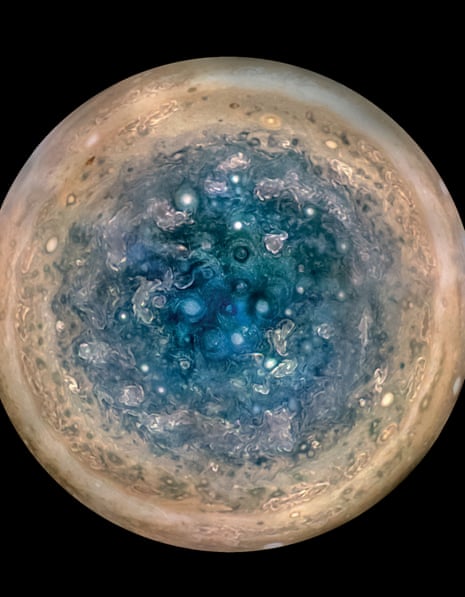
NASA spacecraft have captured stunning images of Jupiter, offering views both up-close and from afar. These images reveal the planet’s swirling storms, colorful cloud bands, and iconic Great Red Spot, giving scientists and the public alike a detailed look at the gas giant.
Close-Up Views From Juno
The Juno spacecraft, launched in 2011, has been orbiting Jupiter since 2016, providing unprecedented close-up images of the planet. Its cameras and instruments allow scientists to study:
- Jupiter’s polar regions, which were largely unseen before Juno
- The intricate cloud patterns and storm systems
- Magnetic and gravitational anomalies to understand the planet’s interior
Juno’s high-resolution images reveal the dynamic atmosphere and offer insights into how the planet’s storms form and evolve over time.
Distant Views From Voyager and Hubble
Long before Juno, the Voyager 1 and 2 spacecraft provided wide-angle images of Jupiter during their flybys in 1979, capturing the full planet in its solar system context. Similarly, the Hubble Space Telescope continues to take distant images that allow scientists to monitor changes over decades.
These far-away perspectives are important for tracking:
- Long-term changes in the Great Red Spot
- Seasonal shifts and atmospheric dynamics
- Jupiter’s moons and ring system
Scientific Importance
Images from both near and far help scientists understand Jupiter’s complex weather patterns, magnetic field, and interior structure. They also provide critical data for comparative studies of other gas giants and exoplanets.
Public Fascination
Beyond science, these images inspire curiosity and wonder. The striking colors, massive storms, and sheer scale of Jupiter remind us of the complexity and beauty of our solar system.
Conclusion
Whether captured by Juno up close or by Voyager and Hubble from afar, NASA’s images of Jupiter continue to deepen our understanding of the planet while captivating the imagination of people around the world. 🌌🪐